
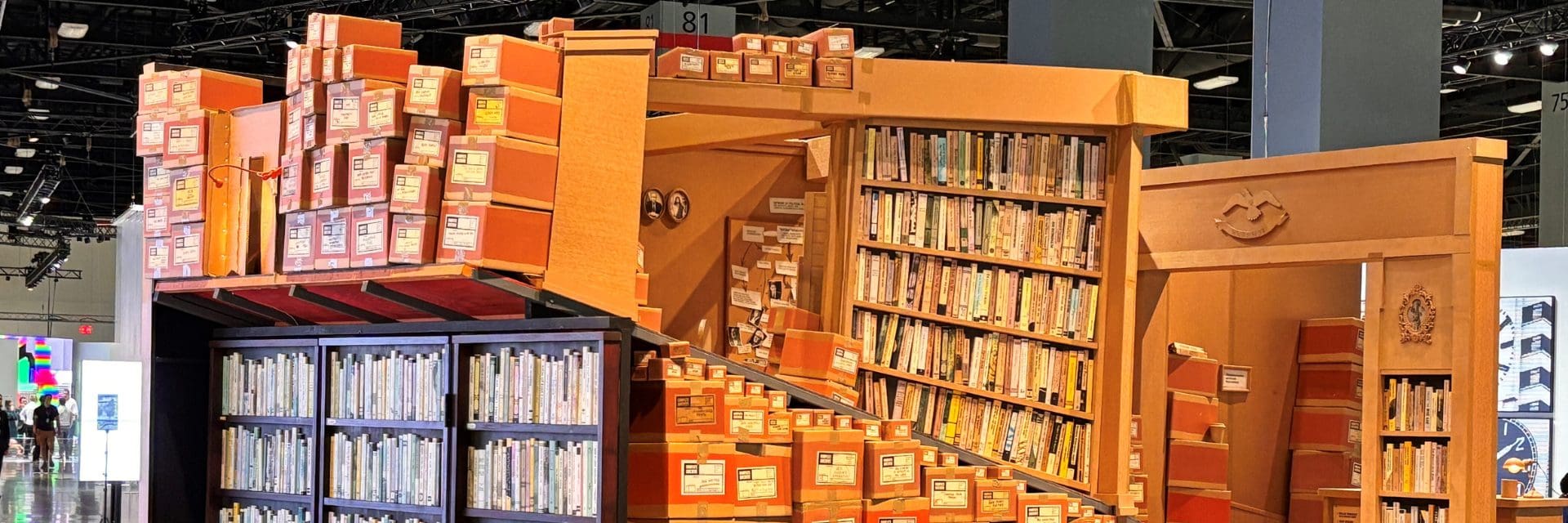
The Last Library IV: Written in Water is an installation by artists Ward Shelley (American, b. 1950) and Douglas Paulson (American, b. 1980). It invites us to think about how we understand truth, evidence, responsibility, and the uncertain state of the world. The installation features dangerously tilted shelves filled with banned books, controversial publications, made-up files, state documents, secret plans, and lost records. This clever fake library honors the written word, a tool that has helped drive many of history’s great advances, such as the rise of representative government and the importance of human rights. At the same time, The Last Library IV examines how the reliability of the written word is fading in a world of alternative facts, censored documents, and language shaped by artificial intelligence.
For more than five thousand years, the written word has helped build fairer societies. As the modern era began, writing became a key part of democracy, creating shared understanding, common laws, and the ideas that support strong institutions. Without writing, words like evidence, authority, and the rule of law lose their meaning, even though written documents shape our beliefs, hopes, and expectations. For centuries, people trusted words to establish facts. But in today’s post-Truth Era, it is harder to tell fact from deception or fiction from fantasy, especially when words appear on both paper and screens. The Last Library IV’s crowded shelves, hidden documents, twisted viewpoints, and slanted floors challenge us to find the truth among many confusing and often controversial sources. In this installation, Shelley and Paulson place political propaganda, misleading ads, fake archives, and corporate interests alongside the Magna Carta and the Declaration of Human Rights.
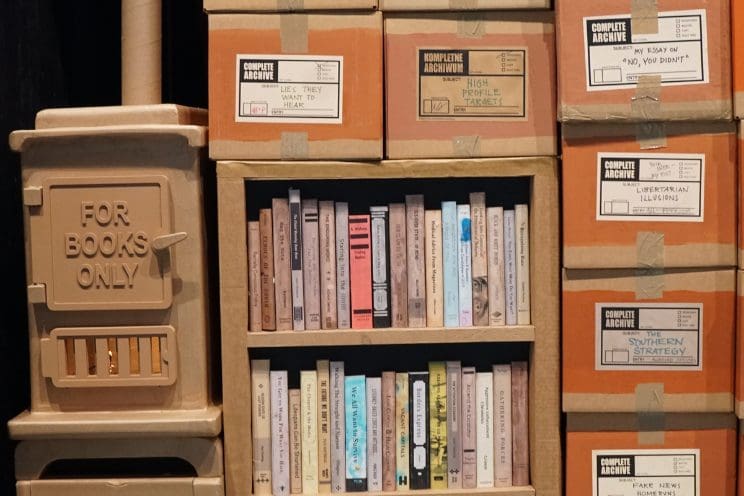
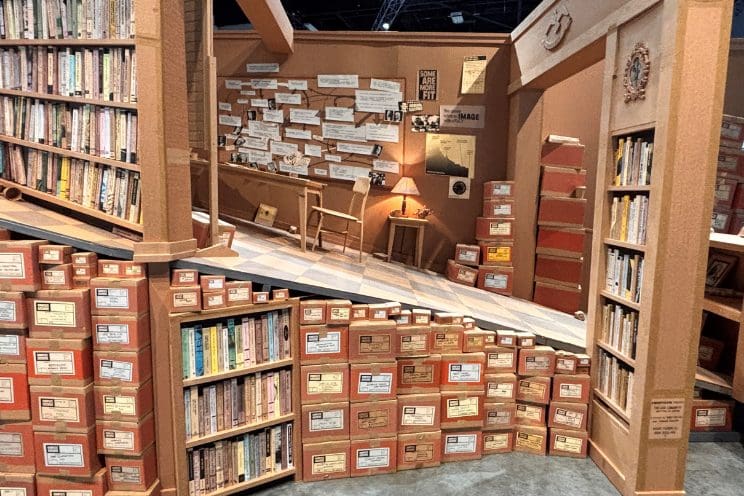
The Last Library IV is mostly made from plain corrugated cardboard, a material that is strong but doesn’t last, symbolizing how our world can seem solid but is actually fragile. Shelley and Paulson’s detailed mix of fake books, real titles, confusing diagrams, and questionable documents encourages us to think about how much we can trust the written word, and even makes us wonder about the future of democracy.

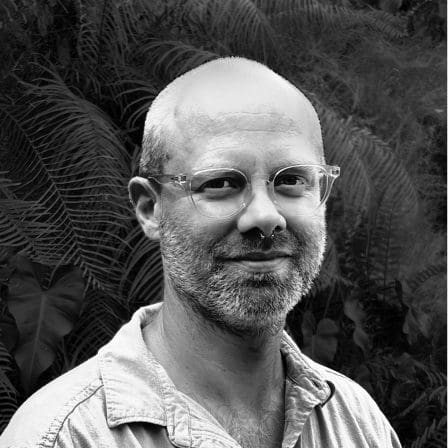
ABOUT THE ARTISTS
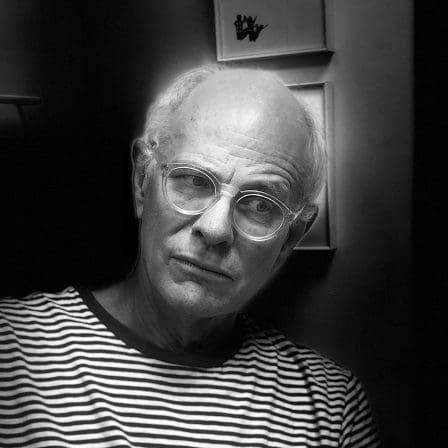
Ward Shelley and Douglas Paulson have been collaborating in performance and installation projects since they met in Brooklyn in 2004. Their most-often cited works are the Archive projects and the Last Library series, in which rooms full of sculptural objects, typically books and boxes, become immersive sculptural supports for text. They have also made inhabited structures in which they lived and worked, such as Flatland with Alex Schweder, and have collaborated with artist collectives in Queens, New York.
The text material in The Archives and Last Libraries reflect the artists interest in the plight of contemporary culture and how it has been shaped by mass media technologies and the needs of the powerful. Popular internet memes, trendy political jingoism, lost histories, commercial slogans and notions of individualism are all in play. These pieces are designed for immersive browsing and reflection. No two person’s experiences will be the same.
Shelley and Paulson have exhibited together more than 25 times across the United States and Europe, but centered in the New York area. Shelley also makes informational diagrams and inhabited performance architecture with Alex Schweder. He splits his time between Connecticut and Florida. Douglas Paulson has years of experience working in the artist collective scene and teaches at Parsons, New School University. He lives in Queens, NY.
MADE POSSIBLE WITH FUNDS PROVIDED BY THE CITY OF ST. PETERSBURG AND THE MARGARET ACHESON STUART SOCIETY


MEDIA PARTNER: WUSF: YOUR HOME FOR NPR / WSMR CLASSICAL

Featured Images:
Ward Shelley (American, b. 1950) and Douglas Paulson (American, b. 1980), The Last Library IV: Written in Water (detail), 2025, Paper, wood, corrugated cardboard, laser-printed and hand-written labels, packing tape, acrylic paint, found and manipulated objects. Installation view. Courtesy the Artist. Promised Gift of Jill and Jay Bernstein.